CENTENARY
MISSION STATEMENT
RALPH BUNCHE - THE LEGEND AND THE LEGACY
COMMEMORATING DR. RALPH J. BUNCHE’S CENTENARY 2003-2004 |
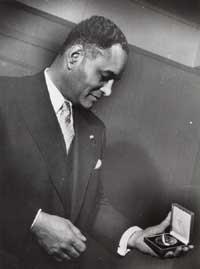
"Nobel Prize - Oslo, Norway- December 10, 1950." |
Dr.
Ralph Johnson Bunche’s life and achievements are surely an authentic
American legend. From humble beginnings as a young black man in
America, he achieved many firsts in a racially hostile social environment.
He fashioned several path-breaking careers, in academia, as a civil rights
leader and as a dedicated civil servant in both the United States government
and the United Nations. He was to be the first African-American, or person
of color of any origin, to be awarded the Nobel Prize for Peace. He received
this international honor in 1950 for his success as United Nations Mediator
in bringing about the 1949 Rhodes armistices between Israel and its Arab
adversaries, Egypt, Jordan, Lebanon, and Syria. |
| For all
of Bunche’s pioneering roles in race relations, human rights, decolonization,
and international mediation and peacekeeping, his name is hardly remembered
today. His legacy, however, is too important to be ignored. Hence, this
centenary commemoration. |
| The centenary
will not only pay respect to what Ralph Bunche accomplished. It will, perhaps
even more importantly, underscore the relevance of his agenda for today
and tomorrow. The Centenary Committee will advance special projects
to reintroduce him to America and the world. It will endeavor to attract
widespread participation in a broad range of activities toward the end of
deepened understanding of his historic contributions to the United Nations
and to humankind. It will hope to translate the legend, which is a gift
from the past, into a legacy, which is an instrument for a better future
for humanity. |
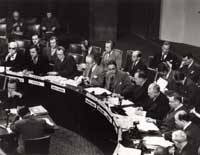
"United Nations Security Council in Session in Paris, 19 October 1948.
Ralph Bunche Acting U.N. Mediator for Palestine." |
Ralph
Bunche saw United States leadership and involvement in multilateral international
organizations as essential to the goal of peace on earth. From 1946 until
his death in 1971, he served the cause of peace as an international
civil servant. He had helped create the United Nations at San Francisco
in 1945 and had a central role in the adoption of three forward looking
chapters of the UN Charter that dealt with post-war colonialism.
For two decades, as Under-Secretary-General -- the highest post held by
an American in the UN -- he played a leading role in the conception and
conduct of the UN’s peacekeeping function. He was, indeed, “Mr.
Peacekeeping.” |
| Bunche
was also a scholar and an early student of Africa and the problems of race.
His prize-winning dissertation on colonialism in Africa earned him a Ph.D.
in government and international relations at Harvard University. His field
research in Africa also contributed to his study, A World View of Race.
He became a professor and first chair of the new political science department
at Howard University. He was president of the American Political Science
Association. Before World War II, he was a key member of the small research
team assembled by the noted Swedish scholar, Gunnar Myrdal, which produced
An American Dilemma, the historic study on race in America. He
was a life-long activist on race and civil rights issues. In 1936, he was
a founder of the National Negro Congress. Late in his life,
he was with Martin Luther King and other black leaders in the march on Washington,
and was prominently visible in the front rank with Martin Luther King in
the march from Selma to Montgomery. |
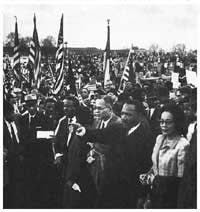
"Bunche on the march from Selma to Montgomery, March 21, 1965" |
Ralph
Bunche was proud of his race, and he fought to advance the cause of minorities
and the oppressed. His career, however, transcended racial identity. We
honor him now, simply, as a great American and internationalist. The Ralph
Bunche Centenary program will be a prism, enabling all who join in the
enterprise to translate his record into insights and impetus toward a
better future for humankind. |
Participating
organizations may commemorate Ralph Bunche’s life through such activities
as conferences, panels at conferences, lectures, essay contests, local
TV/radio programs, Ralph Bunche Day, exhibits, etc. The organizing
committee has identified the following themes that can serve as a focus
of an activity:
The Scholar-Activist: Ralph-Bunche's Dilemma
Civil Rights and Race - An American Dilemma Revisited
The Integrity of Public Service, International and National
Self-Determination and Decolonization
Mediation, Negotiation, and Peacekeeping
A New Generation Looks at Ralph J. Bunche
Africa
The Arab-Israeli Conflict
The U.S. and Africa |
The relevance of the Bunche legacy can perhaps best be explored by
thinking about which of his qualities would be most important to replicate
in the present or the next generation of engaged scholars or thoughtful
practitioners:
The depth of his humane commitment that inspired him
to help liberate "have-nots" and improve their living conditions
in his work on domestic race relations and decolonization, especially
in Africa;
His ability to manage the tension between solid scholarship
and engagement in the world as demonstrated by his PhD research and
work on An American Dilemma side-by-side with civil rights
activism and international negotiations;
His "out-of-the-box" vision as demonstrated
by his commitment to multiculturalism, multidisciplinarity, and internationalism
before they were widespread;
The integrity of his public service throughout his
career in the U.S. State Department and in the United Nations;
His acuity, persistence and patience in mediating disputes
and differences and bringing diverse peoples and perspectives together;
and
His selflessness in placing his patriotic and internationals
goals first, often to the detriment of his family and certainly at great
cost to his own health.
|